Corrado Levi
Entre amis
curated by Yari Miele
with a text by Riccardo Previdi
Opening:
Wednesday, 28 May
6 – 9 pm
Until 27 June 2025
by appointment only
write to spaziolima @pconp.com or whatsapp +393478212305

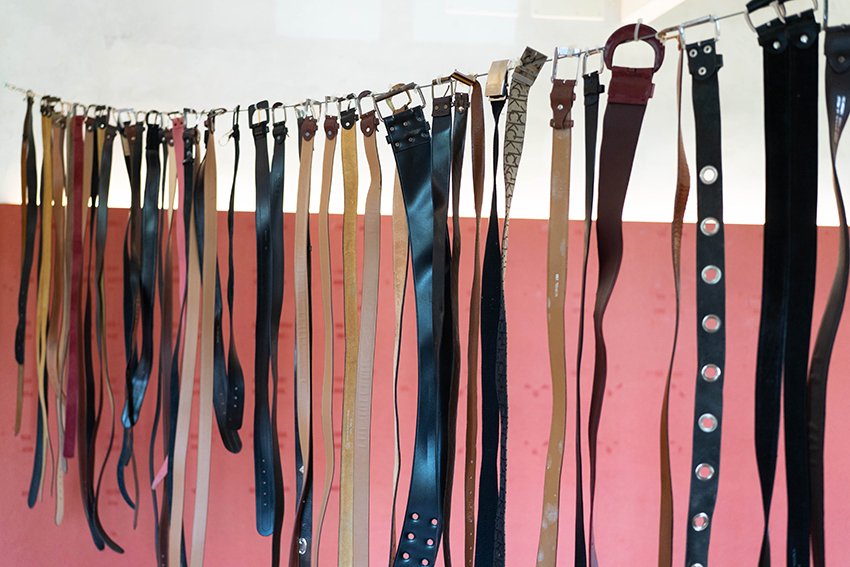
To do this, Corrado installs Desiderando gli amici (1992), treating it as though it were a volleyball or tennis net. The work consists of a taut steel cable stretched diagonally across the exhibition space, dividing it into two triangular sectors, almost recalling set squares.
Hanging from this cable are belts of various shapes and colors, once owned – as the title suggests – by friends. But perhaps this device that reshapes space, this element that divides while still allowing passage, also recalls the colorful curtains once seen at the entrances of small shops in summertime, used to keep flies away. A net, a curtain, or perhaps… a hall of fame.

These languid presences — still bearing the imprint of the bodies that wore them, deformed like snake skins shed after molting — despite their lightness and playfulness, exude an erotic charge that echoes the Presagi di Birnam (Birnam Omens) by Levi’s friend Carol Rama.
Though they can be crossed (or perhaps we should say passed through), these old belts offer caresses to those who courageously venture through the work. And they push us to break the first rule of any institutional exhibition space: “Do not touch the artwork.”


Occupying this unusual playing field are two additional works: a Lampada Edipo (2003) and the rose vase Il Cangiante (1986), the name of which refers to the important group show of the same title curated by Corrado Levi at the PAC in Milan that same year. Objects suspended between function and pure aesthetic enjoyment. Functional art or artistic design? Neither! The intention is rather to reaffirm that the most fertile territory for sowing is that fecund space of in-between.
Corrado Levi’s approach opens up possible spaces, working through shifts and interstices. The point is no longer to define or close off, but to remain in tension, fostering attentive listening — aware that things are never static, but in constant transformation, in an oscillating movement and, indeed, changing: Cangiante!
Thank you, Corrado, for this precious lesson.
Riccardo Previdi


Corrado Levi
Corrado Levi, born in Turin, is an intellectual with a multifaceted background and career. As an architect, he graduated in Turin under Carlo Mollino, was assistant to Franco Albini at the Istituto Universitario d’Architettura in Venice, and later obtained the chair of Architectural Composition at the Faculty of Architecture at the Politecnico di Milano, where he mentored countless students. In his teaching, he has always combined artistic and architectural experiences. His professional work has ranged from interior design to architecture, earning him the INARCH Prize (1966) for the best industrial building. In 1997, he renovated the Museum of Contemporary Art in Guarene for the Fondazione Sandretto Re Rebaudengo.
In the arts, having been introduced to modern art by his collector father, he has accompanied various movements: the Arte Povera, whose syntax he observed; the Transavanguardia, whose freedom he appreciated; and the East Village and Graffiti scenes in New York, whose street energy he envied. He played an active role in the 1980s art movement as an animator, critic, and peer, organizing the first
exhibitions of that generation’s artists in his Milan studio. In 1991, he received the Francesca Alinovi Prize.
As an artist, he regularly exhibits with the galleries Fabbrica Eos, Ribot, Franco Toselli, and Artra. He has held numerous solo exhibitions in Italy and abroad, including: Puck Building, New York (1983); Brown Boveri, Milan (1985); XI Quadriennale, Rome (1986); Wessel O’Connor, New York (1990); Guido Carbone, Turin (1990); Rocca di Umbertide (1990); Studio Cristofori, Bologna (1992); Studio Simonis, Paris (1999); Castello di Rivara, Turin (2000); San Filippo Neri, Turin (2002); Calcografia Nazionale, Rome (2002); Italian Cultural Institute, Rabat (2006); GAMeC, Bergamo (2010); Tate Modern, London (2010); Ca’ Rezzonico, Venice (2015); and Triennale Milano (2018 and 2020). In 2014, he performed at the Teatro Scientifico Bibiena in Mantua, curated by Franco Piavoli. In 2011, he was invited to the Italy Pavilion of the Venice Biennale abroad in Rabat, curated by Vittorio Sgarbi, and in 2014 to the 14th International Architecture Exhibition of the Venice Biennale, curated by Cino Zucchi.
He has also exhibited in several independent spaces in Milan, including Mars, Peep Hole, Lucie Fontaine, Le Dictateur, and AlbertoAperto. As a writer, he considers himself a disciple of Karl Kraus’s aphorisms and Erik Satie. He has published essays on Filippo de Pisis, M.C. Escher, Alighiero Boetti, Mario Schifano, Carla Accardi, Otto Dix, and Carol Rama, as well as articles on young Italian artists, for whom he ran a column in Flash Art for one year.
As a curator, his projects include: Trementina eccitata, Studio Cristofori, Bologna (1986); Il Cangiante, PAC Padiglione Arte Contemporanea, Milan (1986–87); Spunti di giovane arte italiana, Buades, Madrid and Palau Solleric, Palma de Mallorca (1988); Specificazioni della nuova arte italiana, Riverside Studios, London (1989); Esso Gallery, New York (1997); the 45th Venice Biennale; Alighiero Boetti – Quasi tutto with G. Di Pietrantonio, at GAMeC Bergamo and Fundaciòn Proa, Buenos Aires (2004); Fondazione Sandretto Re Rebaudengo, Turin (2004); and Stefano Arienti, MAXXI, Rome (2004–2005).
As an activist, he was actively involved in the Student Movement of 1968 and beyond. He was one of the leading figures of F.U.O.R.I. (United Revolutionary Italian Homosexual Front) along with Mario Mieli and others, where in 1972–73, for the first time in Italy, self awareness groups were practiced—talking about oneself by sharing different experiences. This occurred before F.U.O.R.I. joined the Radical Party and shifted toward civil rights advocacy; at the time, like the feminist movement, the goal was a broader societal transformation.
Writings on his artistic work include contributions by: Elena Pontiggia, Beppe Finessi, Luca Massimo Barbero, Damiano Gulli, Maria Villa, Federico Sardella, Giacinto Di Pietrantonio, Fabio Carnaghi, Michele D’Aurizio, Simone Frangi, Marco Tagliafierro, Giorgio Verzotti, Bettina Della Casa, Luca Beatrice, Angela Vettese, Alberto Mugnaini, Francesca Alfano Miglietti, Lea Vergine, Viana Conti, Ida Giannelli, Achille Bonito Oliva, Guido Curto, and Hans Ulrich Obrist.
He appears in the 2014 documentary Felice chi è diverso by Gianni Amelio.
He holds a Silver Glove in Savate boxing.
Yari Miele
Born in Cantù (Como) in 1977, he graduated in 1997 from the Fausto Melotti State Art Institute and earned a degree in Painting from the Brera Academy of Fine Arts in Milan in 2003. He took part in workshops with Carla Accardi, Gilberto Zorio, and Corrado Levi. He continued collaborating with Levi in his studio, and later worked with the Marion Baruch Archive.
Since 2013, he has been co-director of MARS (Milan Artist Run Space), and since 2016 he has collaborated with the Albertoaperto space. He has been featured on ItalianArea since 2018, and since 2020 has worked with Nicoletta Rusconi on the ArtBite/Bite&Go project. His works are part of the Colombo Industrie Tessili collection and the State Archive of Modena.
His research explores the experience of vision through an investigation of light and its absence, reflecting on space as both a physical and metaphorical entity. His works create a dialogue between inner perception and external observation, between what is lit and what is dark, generating reflections that alter space and reveal new, hidden forms suspended in emptiness.