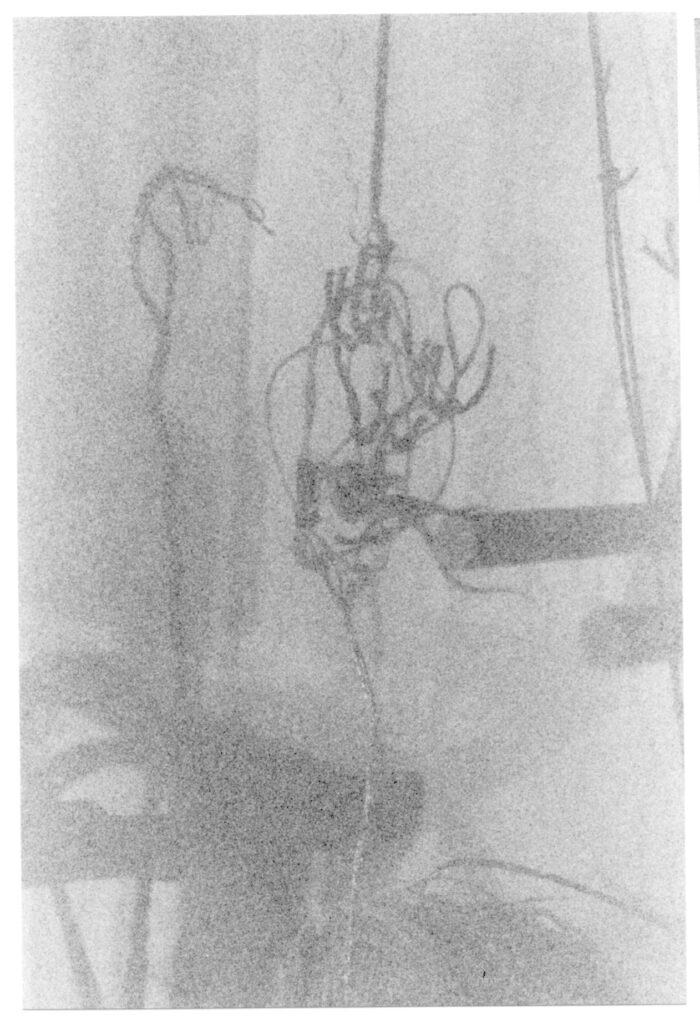
Alek O.
La Prima Rosa

For this year’s edition of Milano Design Week, pconp is pleased to welcome at Spazio Lima La Prima Rosa, a solo project by Alek O
Orari
Opening 08/06
h. 6 – 9 pm
09/06 – 12/06
h. 11 am – 6 pm
13/06-29/07
by appointment only
write at spaziolima @pconp.com
or whatsapp +393478212305
The imagery brought to the stage by Alek O. is located in a dimension poised between past and future, between preservation and innovation, between remembrance and tension towards the coming time. The objects used to give body to her works are chosen not so much, or not only, for their aesthetic value, but for their emotional bearing: the net of a mattress, some discarded tiles, a now-dried flower, as well as the wool of a sweater or a pair of gloves are recovered from their original, usually domestic, use, are transformed, yet they retain the imprint of the person who owned or used them-often the artist herself-and are witnesses of his/her own history.

We could call Alek O.’s a poetics of the human, which also translates into the delicate manifestation of an error, an imperfection, an intimate, more hidden experience that tells of a domestic environment, to be sought in the details.
For example, in the choice of a wrong light bulb to illuminate a room. An error that shows itself and permeates every time the switch is turned on, a forgotten carelessness, which, in its repetition becomes with time familiar and welcoming. The simple gesture of turning on the light loses its function, but becomes charged with humanity.


The objects, the ‘things’ used (such as the tiles in the case of the sculptures in the ‘Minecraft’ series and the mattress nets in the installation ‘There was a lot of waiting’) often come from the world of craftsmanship and industry, the result of the work of expert hands and time-tested techniques, have their own alphabet and grammar, which Alek O. appropriates by distorting it, not creating, but re-creating a new language.
And so the nets, without their own frame, lose their function but retain the memory of what they had been. The grid structure, deprived of tension, is transfigured and reshaped into new patterns. It falls lightly like a precious curtain, living in space with a new guise, a new role.


The transformation also becomes, in the artist’s eyes, a possible means of preserving the memory, of a moment, of an object, giving it a different form, but one destined to last. The first rose given to the artist by her son can be preserved only if it is dried and stabilized: as graphic marks on the canvas, the rose petals no longer return the image of the flower we all recognize, they build an abstract composition, which speaks a more modern and universal language.


Alek O.
In her practice Alek O. (Buenos Aires, 1981) blends the common notion of the readymade with craft, embroidery and other traditional art-making forms. On the verge between transformation and conservation, Alek O. strips the objects’ common visual aspects and replaces them with geometric abstraction. Reversing the perspective of design, Alek O. favours re-creation over creation and deconstruction over construction.
The objects, chosen for their emotional quality, are salvaged from their original, usually domestic use: wood from a bookshelf, metal from a discarded key, wool from a sweater or a pair of gloves. Thus, the works function as metonymy for the artist, or the people who had a connection with the material. The imprint on her sculpted material of those who owned it or used it represents an important aspect of Alek O’s work as « it encapsulates a series of questions/suggestions where memory, affection, nostalgia and the carefully considered loss of interpretive information converge to create an open poetic gesture ».
« Fundamentally, all of Alek O.’s art is an invitation to open up to observing reality and allow ourselves to be convinced that everything, be it an image, object or thought, can be renamed without losing meaning, but acquiring others ». [Luca Lo Pinto, 2013]
Alek O. lives and works in Milan, where she graduated in Design from Politecnico. Among her most recent solo exhibitions: Parolacce, Fondazione Zimei, Pescara (2022), L’impero delle luci, Frutta, Rome (2017); Time Goes By So Slowly, Jeanine Hofland, Amsterdam (2016). The artist’s work has been largely exhibited at an institutional level, particularly at the National Gallery of Modern and Contemporary Art, Rome, The Courtauld Institute of Art, Somerset House, London; Casa Testori, Novate Milanese; Nomas Foundation, Rome; Kunst Meran, Meran; Fondazione Zegna, Trivero; 16th Art Quadriennial, Rome, Palazzo delle Esposizioni; Art Situacions I-II, SPAIN / ITALY, Villa Croce, Genova, MACRO, Rome; Triennale di Milano; Studio Castiglioni, Milan; Fondazione Sandretto Re Rebaudengo, Guarene; Prague Biennale 5, Prague; V Bienal de Jafre, Spain; Castello di Rivoli, Turin; Centro per l’arte contemporanea Luigi Pecci, Prato; Fondation Cartier pour l’art contemporain, Paris.